
the cathedral
- Philippe Braquenier
For the first time in more than twenty years, the number of autocratic regimes worldwide exceeds that of liberal democracies. According to the Democracy Report 2025 published by the V-Dem Institute at the University of Gothenburg, 72% of the world’s population currently lives under an autocratic regime, compared to 49% in 2004. Over the course of a single generation, this shift has occurred almost silently. Not through the spectacular military coups characteristic of the twentieth century, but through a gradual erosion of institutions, the normalization of authoritarian discourse, and the progressive weakening of democratic imaginaries.
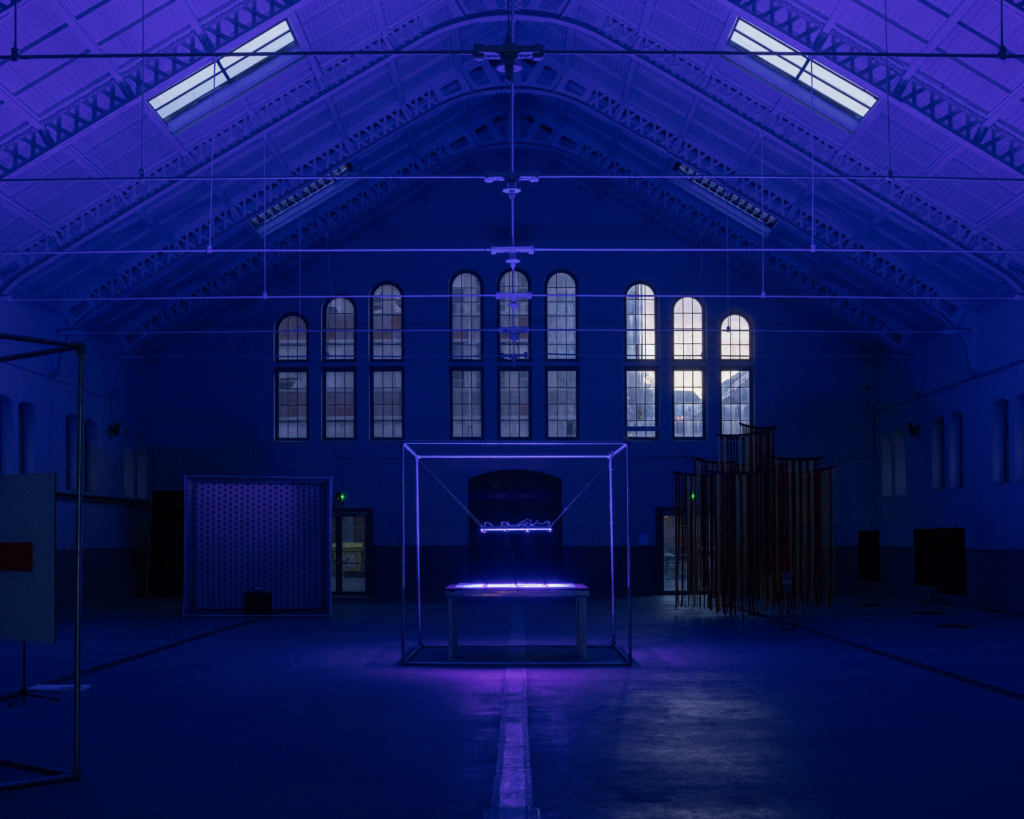
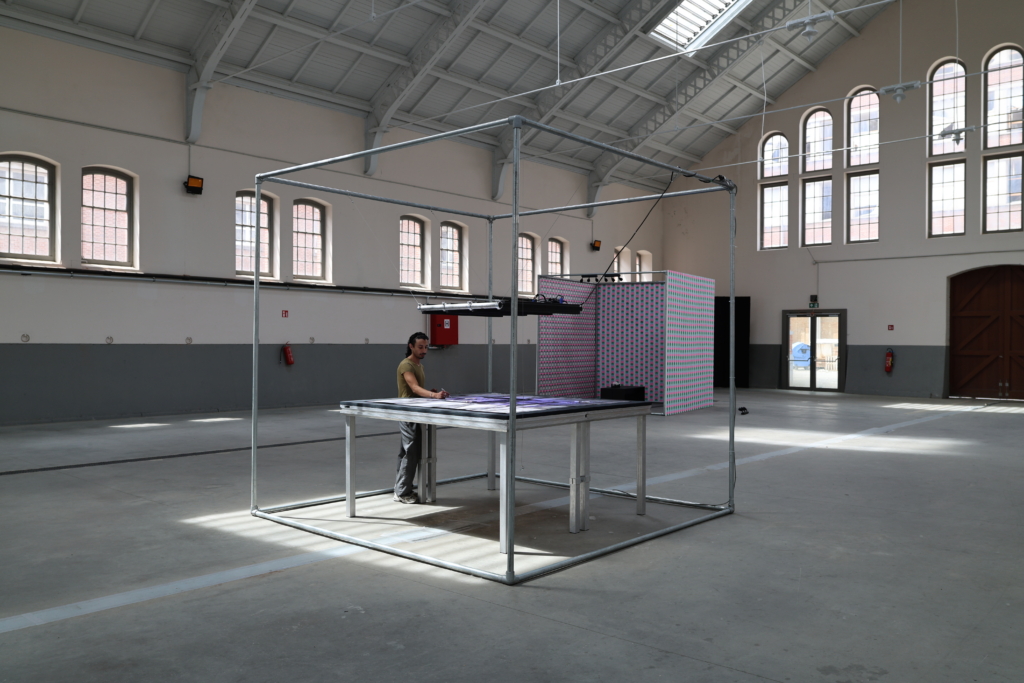
The cathedral emerges from this observation.
The project explores the dissolution of democratic values through the territory of Brussels, approached as a political, symbolic, and architectural laboratory. As the capital of Belgium and the seat of the main European institutions, Brussels is often perceived as the embodiment of a Western democratic ideal, itself rooted in the political legacy of the eighteenth-century Enlightenment.
It is therefore no coincidence that the project draws on the theories of the Dark Enlightenment, a neo-reactionary intellectual movement developed in the early 2010s around figures such as Curtis Yarvin and Nick Land. Opposed to the egalitarian principles inherited from the Enlightenment, this movement views liberal democracy as an inefficient system destined to collapse. Within this worldview, democratic institutions are understood as an illusion of participation concealing a form of power already captured by invisible cultural and bureaucratic structures: universities, media, administration, and cultural production. This informal structure of power is referred to as “the cathedral.”
The title of the project directly refers to this ambiguous notion. Here, the cathedral is no longer a religious building, but an ideological architecture: a diffuse and omnipresent system of beliefs that organizes society while claiming to embody moral and political neutrality. At the same time, the title also functions as a broader metaphor for a Western civilization built upon narratives of progress, stability, and rationality, whose foundations now appear increasingly fragile.
Across many Western democracies, a growing sense of political powerlessness has emerged. Voting no longer seems capable of producing meaningful transformation. Institutions appear simultaneously omnipresent and unable to respond effectively to the crises they face. In this context, the Belgian political system constitutes a particularly singular case study. Built upon a complex balance of permanent compromise and coalition governments, it relies on an institutional architecture designed to prevent any excessive concentration of power. Mechanisms of proportional representation, multiple levels of governance, and the cordon sanitaire established around the far right all contribute to this historical attempt to preserve a fragile democratic equilibrium.
Yet The cathedral is precisely concerned with what escapes these protective mechanisms. The project questions how executive power and successive political figures have gradually succeeded in dismantling different levels of institutional power over time.
Contemporary democracies do not necessarily disappear through sudden collapse. Rather, they transform slowly, sometimes imperceptibly. The structures remain in place while their substance is progressively emptied.




Agenda
Past
Created by
Philippe Braquenier
Philippe Braquenier is a Belgian visual artist based in Brussels, Belgium.
Fascinated by knowledge; intrigued by how it is collected, used, shared and stored. His work prompts a discourse about our obsession to deal with information in a time when data is becoming ever more omnipresent, yet all the more unseen. With a restrained and impassive perspective, Braquenier then connects these ideas to those on a much larger scale, of evolution, heritage and the preca- rious character of the digital revolution.
He received a Bachelor in photography from the HELB and worked in the advertising industry until 2016. Since his professional shift, he has exhibited at the Aperture Foundation in New York, the Belgian pavilion during the Venice Biennale in 2018 and the JIMEI X ARLES Photo Festival, among other institutions and galleries.
He was a finalist of the Louis Roederer Discovery Award (Les Rencontres d'Arles) in 2020.
Credits
Artist: Philippe Braquenier
Production: Ohme